

Modern Vastu often relies on angular division techniques and the Shakti Chakra compass—tools that appear geometric but are actually borrowed from Feng Shui’s Bagua system and Wu Xing elemental logic. This creates a directional model very different from the fixed spatial mapping of the Vedic Vastu Purusha Mandala. Modern Vastu Shakti Chakra distortion/problem is the most important aspect one needs understanding.
In this article, I explain why these angular-based interpretations distort the classical pada-vinyasa framework, how the Modern Vastu Shakti Chakra compass mirrors Bagua life-area mapping, and why mixing Vedic and Wu Xing principles results in conceptual contradictions.
To fully appreciate the discussion ahead, I recommend reading our previous article linked below. It provides a solid foundational background and the essential conceptual clarity needed before exploring the deeper distinctions presented here.
A natural question might arise: “So are you suggesting that Feng Shui has no fixed geometric or directional model?”
It does—through the Bagua map, which is its primary spatial template. However, the Bagua’s directional scheme is built on Feng Shui’s own symbolic cosmology, not on the spatial–energetic logic of Vastu, and therefore cannot be overlaid onto the Vastu Purusha Mandala without distortion.
| Direction/Location | Life Area (Gua) | Wu Xing Element | Symbolic Focus |
| North (Kan) | Career, Life Path | Water | Flow, wisdom, deep purpose. |
| North-East (Gen) | Knowledge, Self-Cultivation | Earth | Inner clarity, learning, stability. |
| East (Zhen) | Family, Health, Ancestors | Wood | Growth, community, new beginnings. |
| South-East (Xun) | Wealth, Prosperity | Wood | Expansion, abundance, financial gain. |
| South (Li) | Fame, Reputation | Fire | Visibility, passion, recognition. |
| South-West (Kun) | Relationships, Marriage | Earth | Nurturing, partnership, maternal energy. |
| West (Dui) | Children, Creativity, Future | Metal | Joy, completion, artistic expression. |
| North-West (Qian) | Helpful People, Travel | Metal | Support, mentors, movement, paternal energy. |
| Center | Health, Unity | Earth | Balance, overall well-being, transition. |
Why the Bagua Chart Is Mentioned in This Discussion
• Not for elemental directions.
The Bagua chart’s elemental–direction associations are not even relevant to Modern Vastu interpretations.
Modern Vastu simply uses Wu Xing elemental sequence logic mixed with Vedic Vastu understanding of certain directions such as North, East, South-East, and North-East.
• Because Bagua abandons the Wu Xing elemental sequence when forced onto architecture.
- The moment the Bagua map is superimposed onto a fixed floor plan, it breaks its own Wu Xing sequential cycle.
- This alone shows that Wu Xing elemental sequence was never designed as a spatial or architectural mapping tool. Why else bagua map discard it ?
- Wu Xing is a cyclical/phasic model (Wood → Fire → Earth → Metal → Water) describing transformations and interactions; it is not a fixed architectural grid.
Bagua Directional Sequence (Element → Element → …)
Following the directional order:
North → North-East → East → South-East → South → South-West → West → North-West → Center
The corresponding elemental flow becomes:
Water → Earth → Wood → Wood → Fire → Earth → Metal → Metal → Earth
Wu Xing Cyclical / Phasic Sequence
Wood → Fire → Earth → Metal → Water → (repeats)
Direct Comparison — Where Bagua Breaks the Wu Xing Cycle
If Bagua were following the Wu Xing generation cycle, the directional sequence would have to move:
Wood → Fire → Earth → Metal → Water → Wood → Fire → …
But the actual Bagua sequence is:
Water → Earth → Wood → Wood → Fire → Earth → Metal → Metal → Earth
This creates obvious mismatches between Bagua and Wu Xing elemental sequence .
- Water does not generate Earth (in Wu Xing, Water generates Wood).
- Earth does not generate Wood (in Wu Xing, Earth generates Metal).
- Wood does not generate Wood again — the cycle must progress.
- Metal appears twice with no generative movement.
- Earth repeats multiple times, further breaking the sequence.
The Core Question
If the Bagua Map itself does not use the Wu Xing elemental sequential logic for architectural spatial mapping,
Why does Modern Vastu depend on it? I shall leave that to individual interpretation.
The Only Actual Relevance of the Bagua Map Here
The real connection is simply this:
Its life-area (Gua) layout strongly resembles the “Shakti Chakra Compass” attributes used in Modern Vastu.
The organizational borrowing is visible as:
- North → Career & Life Path
- North-East → Knowledge & Self-Cultivation
- East → Family, Health & Ancestors
- South-East → Wealth & Prosperity
- South → Fame & Reputation
- South-West → Relationships & Marriage
- West → Children, Creativity & Future
- North-West → Helpful People & Travel
- Center → Health & Unity
How Modern Vastu Uses This Structure
- The Shakti Chakra Compass assigns one keyword per direction, mirroring Bagua’s 8 Gua.
- The 8 additional sub-directions simply lift one attribute from one of the two Devata padas present in each sub-zone to put in the shakti chakra .
- The second Devata in that zone is ignored completely.
Example: The SSW Zone
- Modern Vastu labels it “Disposal” based on the Bhringaraja pada (“letting go”).
- But the same region also includes the Gandharva pada, connected to:
- Art
- Music
- Creativity
- Aesthetic expression
- These have nothing to do with disposal, showing selective interpretation.
This reduction of complex multi-layered Devata fields into single convenience-based tags breaks the integrity of Classical Vastu.
The Real Problem Exposed
Why borrow Bagua’s life-area structure while discarding its elemental logic?
For example, Bagua assigns:
- Earth → North-East, Center
- Wood → South-East
- Modern Vastu doesn’t use this but lifts the elements of these direction from Classical Vastu.
Yet Modern Vastu:
- Copies Wu Xing elemental cycles,
- Selectively copies Bagua elemental placements,
- Fully copies Bagua life areas,
- Ignores deeper Classical Vastu Devata sub zonal attributes.
This reveals a fundamental issue:
Modern Vastu mixes Vastu’s spatial principles with Feng Shui’s symbolic/temporal logic — selectively and inconsistently — creating a system unable to defend its own coherence.
I am sure the creators of Modern Vastu have their own reasoning based on various considerations. But the deviation from both Feng Shui and Classical Vastu is clearly demonstrated here.
Abandonment of the classical Pada Vinyasa method
A second major distortion is the abandonment of the classical Pada Vinyasa method, a core foundation of Vastu Shastra, and its replacement with angular-division techniques namely Shakti chakra compass —ironically, another fundamental principle taken directly from Bagua angular division mapping . By discarding the true Vastu method and replacing it with imported angular slicing, Modern Vastu loses both its philosophical and architectural integrity.
A Matter of Integrity: Why Such Claims Are Offensive
The conclusion is simple and consistent: if one chooses Vastu, follow Classical Vastu; if one chooses Feng Shui, follow Feng Shui.
Mixing the two systems inevitably creates confusion, distortion, and unreliable results.
I am not here to argue which of these two traditional frameworks is “better” or “superior.” That is not the intention of this work. The motivation behind this entire effort comes from a much deeper and more personal concern:
When Classical Vastu consultants (not just me) point out structural or philosophical distortions, many followers of Modern Vastu respond by claiming that their method is correct and that Classical Vastu—or even the entire pada vinyasa system—is “wrong,” “outdated,” or capable of producing “disastrous results.”
This is deeply concerning and, honestly, offensive—because all authoritative Vastu literature, without exception, is built upon the pada vinyasa system. To dismiss it outright not only rejects an entire lineage of knowledge but misrepresents the core of Vedic architectural science.
My article is therefore written only to defend the integrity of the Vedic framework, as found in the shastras and traditional commentaries—not to attack, humiliate, or belittle anyone working within Modern Vastu. Different approaches can coexist, but misrepresenting the classical tradition cannot.
I cannot share the Modern Vastu “Shakti Chakra” diagram here because it is copyrighted, but you can look it up separately—and when you do, the resemblance to the Bagua map’s life-area (Gua) layout is unmistakable. The way Modern Vastu consultants present and use this wheel makes the parallel even clearer.
Why Classical Vastu Zones Cannot Be Reduced to One-Attribute Interpretations
Classical Vastu never assigns a single “life-function attribute” or “result” to any one direction or individual pada. The Vastu Purusha Mandala is an integrated energetic matrix of 45 Devatas, each contributing a different layer of cosmic, elemental, psychological, and structural influence. Human outcomes arise from multiple zones working together, not from isolated sectors. This is exactly why Classical Vastu cannot—and must not—be simplified into “one area = one result” style interpretations.
1. Every Human Outcome Emerges from Multiple Zones
No classical text ever claims that one direction alone governs wealth, health, relationships, or fame. Instead, each outcome arises through the coordinated influence of several Devata fields:
- Multiple padas contribute layers of manifestation.
- Many attributes naturally span 3 or more zones.
- Effects are distributed, not compartmentalized.
- Planetary rulership overlaps with Devata rulership.
This multi-zone governance is what gives Classical Vastu its depth and precision. It is a holistic architectural science, not a fragmented keyword-based mapping.
Example reminder mentioned earlier in previous article: Even the three manifestation zones are not enough to fulfil every desire—because manifestation itself is multi-layered.
2. Modern Single-Sector Mapping Oversimplifies the Mandala
Modern Vastu frameworks often collapse this complexity into a simplistic model where:
- one direction = one keyword,
- one sector = one result,
- one label = one remedy.
This is to clarify that many experienced Modern Vastu practitioners do possess good knowledge of the 45 devatās and their various attributes — but this depth of understanding rarely shows up in their actual consultations. In practice, the process often becomes simplified to: take the shakti chakra compass, place the grid, assign a single-word label to each sector, and complete the remedies within a few hours. This gap between knowledge and application is one of the main reasons the richness of Classical Vastu does not translate into Modern Vastu practice.
This approach breaks the integrity of the classical system and distorts the subtle logic of Devata interplay. The Classical Mandala operates on interdependence, not compartmentalization.
3. Each Devata Pada Shapes Human Consciousness
In Classical Vastu, Devata padas are not just “functional zones”—
they correspond to inner faculties of the human being:
- Subtle psychological qualities
- Cognitive and emotional capacities
- Energetic tendencies
- Chakra-related functions
- Behavioural expressions
When a zone is harmonised:
- The related inner faculty strengthens
- One’s intuition, clarity, and decision-making improve
- Natural capability increases
When a zone is imbalanced, its corresponding inner faculty becomes weaker or distorted.
4. Vastu Aligns the Human Being With the Four Purusharthas
Balanced zones gradually support a person in naturally fulfilling:
- Dharma – right action, clarity of purpose
- Artha – material stability and prosperity
- Kama – fulfilment, joy, creativity
- Moksha – clarity, detachment, inner freedom
Thus, Vastu is not merely about directional corrections—it is about coherence between inner consciousness and external space.
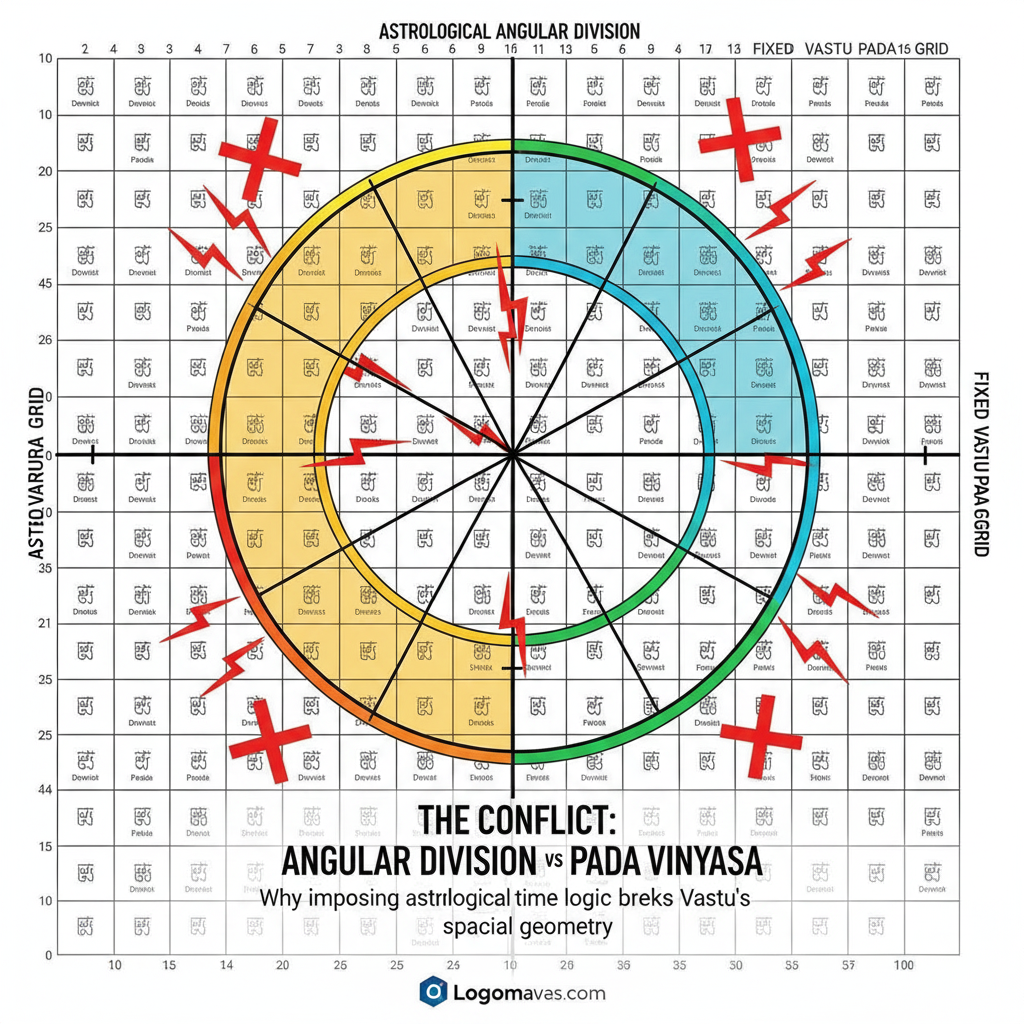
Angular division method is the domain of Astrology, which deals with time.
Repeating myself, Wu Xing describes how energies change through time, mapping phases to seasons, cycles, and symbolic directions within its own cosmological framework. Its tools are all time-dependent, numerological, or astrological, such as:
- Lo Shu Square (Nine Star Ki)
- Flying Stars (Xuan Kong Fei Xing)
- Luo Pan compass systems
- Rotational charts and changing influences
All of these operate on temporal movement, not fixed spatial grids.
By contrast, Vastu Purusha Mandala (using the Pada Vinyasa method) explains how energies exist in space—not how they change over time.
- Pancha Bhutas are fixed.
- The 45 Devatas are fixed.
- The Navagrahas are assigned zonally and remain fixed.
- Nothing rotates or cycles.
Seasonal and daily variations are handled internally through:
- Sthira – fixed
- Chara – seasonal movement
- Nitya – daily variations
None of these require altering the directional map.
Don’t read much in the diagram below . Its inaccurate . that’s the point .

In Vastu, angular division does not belong to architectural analysis.
It is a dedicated domain of Vedic astrology (Jyotiṣa) and is complete in itself.
The problem is not with angular division as a technique—
but where it is applied.
Even though planets appear on the Vastu Purusha Mandala, their function is:
- Zonal,
- Devata-mediated,
- Non-astrological in the Jyotiṣa sense,
though some symbolic parallels exist.
A simple example of third point :
- Wearing the gemstone of a malefic planet can intensify its malefic results (astrology) according to one school of thought in astrology .
- But energizing the corresponding direction in Vastu reduces imbalance by strengthening the Devatas of that zone.
Why Strengthening a Direction Never Aggravates Planetary Doshas
In Vastu, energizing or strengthening the corresponding direction does not worsen a planetary imbalance. It does the opposite.
When a zone is activated correctly, the Devatas of that direction are strengthened, and they, in turn, harmonize the planetary forces expressed there. This is a zonal–devata mediated balance, not a Jyotiṣa-style amplification.
This is why statements like “If Jupiter is malefic, keep a dustbin in the Northeast” are not just incorrect—they reflect a complete misunderstanding of how Vastu actually operates.
These ideas typically arise from misinformation circulated for social media visibility.
In classical Vastu:
- Devatas govern the direction.
- The Devatas influence the planetary expression.
- Strengthening the zone balances planetary effects, not aggravates them.
- Trash or ‘disposal logic’ has no link with planetary malefics in the Vastu Purusha Mandala.
Such misconceptions only distort the tradition and confuse people who are genuinely trying to understand Vastu.
How a zone affects different individuals differently is a separate discussion I have covered in the below article towards the end .
For this reason:
Angular division methods used in astrology should not be imposed onto the Vastu Purusha Mandala,
except in rare cases where:
- The plot is perfectly square, or
- The structure is circular,
because such geometry naturally aligns with angular symmetry.
Classical Vastu even includes triangular mandalas, further proving that its logic is based on:
- Spatial geometry,
- Not angular rotation.
This reinforces the fundamental distinction:
Astrology = time
Vastu = space
Modern Vastu Elemental Logic: Why Directional Color-Therapy–Based Corrections Are Flawed
Modern Vastu often uses color therapy to fix directional imbalances — for example, applying the color of the “previous direction” to enhance an element or using the “next direction’s color” to weaken or counter it. This method is fundamentally flawed.
Why?
Because modern Vastu borrows its elemental color scheme from Wu Xing (Chinese Five-Element Theory) and mixes it into a Vastu framework without understanding:
- the original Pancha Mahabhuta logic,
- the individual’s Ayurvedic prakriti (Vata, Pitta, Kapha),
- or the astrological/planetary color influences that affect a person’s subtle body.
As a result, even the prakriti assignments in the modern Vastu Shakti Chakra become distorted and disconnected from classical Vastu principles.
To understand this in depth, read the full article below.
Still reading ? Congratulations. !!! Years ago I would have left by now . Social media scrolling have compromised up our attention span .
Now we move on to Vedic perspective of cosmological elemental creation and its scientific relevance .
Grab a cup of tea or water if feeling exhausted or come back later and continue from here. Since the article has already become extended we shall continue in our next article . Do read as it will be totally a scientific rendition.
Leave a Reply